Experience highlights
Programmes we have delivered across manufacturing, trading and workforce operations — the problem as the client described it, what we built, and what changed afterwards.
Food manufacturing automation
A food producer running recipes, batches and expiry dates across spreadsheets and paper batch cards.
Recipes and yields were maintained outside the system, so material consumption never matched the plan. Batch records were paper-based, which made any traceability question a manual investigation across production, stores and dispatch.
Recipe-driven bills of materials with yield and scrap handling, lot creation at production, expiry and shelf-life rules on every lot, and barcode-based issue and receipt on the floor.
Forward and backward traceability from raw-material intake to customer delivery available on screen, consumption variance visible per batch, and expiry-driven picking instead of manual date checks.

Car spare parts inventory & production control
Tens of thousands of part numbers, several storage locations, and no reliable answer to "do we have it?".
Parts were listed under supplier codes, OEM codes and local names at the same time. Duplicate items hid real stock, reordering was done from memory, and slow-moving capital sat unnoticed on the shelves.
A de-duplicated catalogue with OEM, aftermarket and cross-reference codes plus vehicle compatibility; multi-location stock with bin-level accuracy; and reorder rules separated by movement class.
Counter staff find parts by any code the customer quotes, stock figures match the shelf, and purchasing works from movement data instead of intuition.
WinDoorERP — windows & doors fabrication ERP
Nawah is the owner and developer of WinDoorERP.com. It began as a client problem we could not solve with configuration alone, and became a product we now license, host and support ourselves.
Estimators priced openings from experience, so two people quoting the same job produced different numbers. Cutting lists were prepared manually after the order, profile waste was unmeasured, and site survey changes rarely made it back into production.
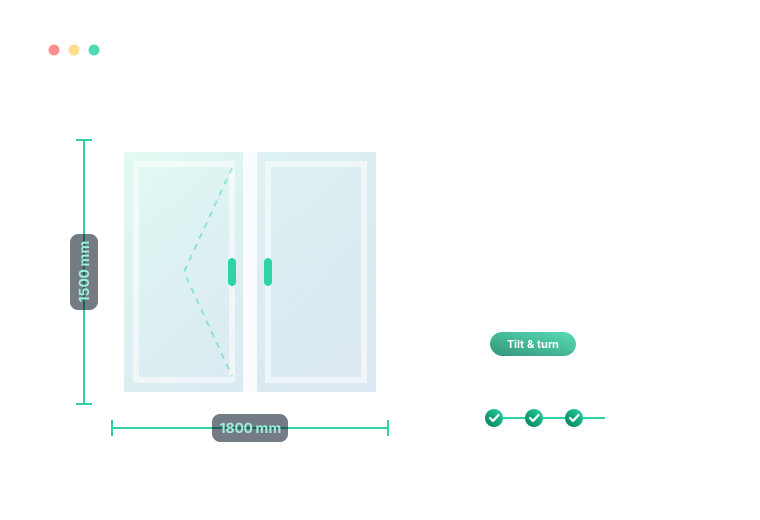
A graphical configurator where each opening is drawn and priced by dimension, profile system and glazing; automatic generation of cutting lists, glass sizes and reinforcement from that drawing; rule-driven hardware selection by sash type, weight and handing; and a survey-to-installation flow that pushes site-measured dimensions back into the production order.
Consistent pricing across estimators, cutting lists produced from the order itself rather than re-drawn, and one record following each opening from quotation through fabrication to installation sign-off. WinDoorERP now runs as a multi-tenant platform, maintained and supported by our team in Doha.
Trading workflow automation
Enquiry, quotation, purchase, delivery and invoice — five steps living in five different places.
Quotations were built in spreadsheets and re-keyed into the accounting package. Discounts were given without a limit, import freight and duty never reached product cost, and management saw margin only after the audit.
A single chain from enquiry to invoice, pricelists with role-based discount approval, landed-cost allocation across freight, duty and clearing, and margin reporting per line, customer and product family.
No re-keying between sales and finance, discounts controlled by policy rather than negotiation, and true landed cost visible before the deal is confirmed.

HR recruitment & payroll systems
A manpower operation where the workforce is the product — and the paperwork is the risk.
Candidate pipelines lived in inboxes, deployed staff were tracked per client on separate sheets, visa and medical expiries were noticed late, and payroll was calculated independently of what the client was billed.
A recruitment pipeline from application to onboarding, one employee master carrying contracts and documents with automated expiry alerts, deployment records per client site, and attendance feeding both payroll and client invoicing from the same timesheets.
Document expiries surface before they become penalties, payroll reconciles to invoicing line by line, and management can see deployment and utilisation per client at any point in the month.
Recognise your own problem in one of these?
Most of them started as "our system is fine, we just need a report". Let's look at what is actually happening in your process.